

The Missing Data on Mature Beauty
The Consumer Everyone Relies On — But No One Actually Studies
Here’s something that shouldn’t shock you: the beauty industry severely undervalues mature women. It’s a conversation we’ve been having for years, as consumer sentiment continues to push brands towards greater age inclusivity across campaigns. And while it’s true that we can observe some improvement in this arena – at least superficially – much still remains a mystery about this quietly powerful demographic.
Broadly speaking, beauty brands have spent recent decades chasing emerging generations in a bid to secure lifelong loyalty early on, which in turn has placed older female consumers far lower on their targeting list. Research has consistently shown that this demographic is still shopping, but most beauty companies struggle to grasp the extent of their spending power.
The numbers alone should be compelling: women over 55 account for nearly half of all beauty product sales across the UK, France and Spain. Responsible for an estimated $15 trillion in global purchasing power, Forbes recognises this cohort as “super consumers”. They buy for themselves but they also shop for everyone around them, including children, partners and friends.
Knowing who this woman is and how she shops is now table stakes — but the challenge is that she’s often missing from the datasets beauty relies on. With a lighter social media footprint and less activity in online forums, women over 40 leave a far quieter digital trail, making them harder to track.
To help close this gap and build a clearer picture of how she shops, we analysed 19,837 skincare reviews left by women aged 40+ across major retailers, alongside mature-aged skincare forums on Reddit. In this piece we will unpack how age functions as social proof, where intergenerational influence actually flows, and why digital discourse tells a different story than sales data alone.
Methodology
Firstly, it’s worth noting that retailer reviews skew excessively positive, with nearly 68% having a five star rating. This reflects what many beauty consumers already know: retail-hosted reviews are curated to drive conversion, rather than to assist shoppers in finding the best products.
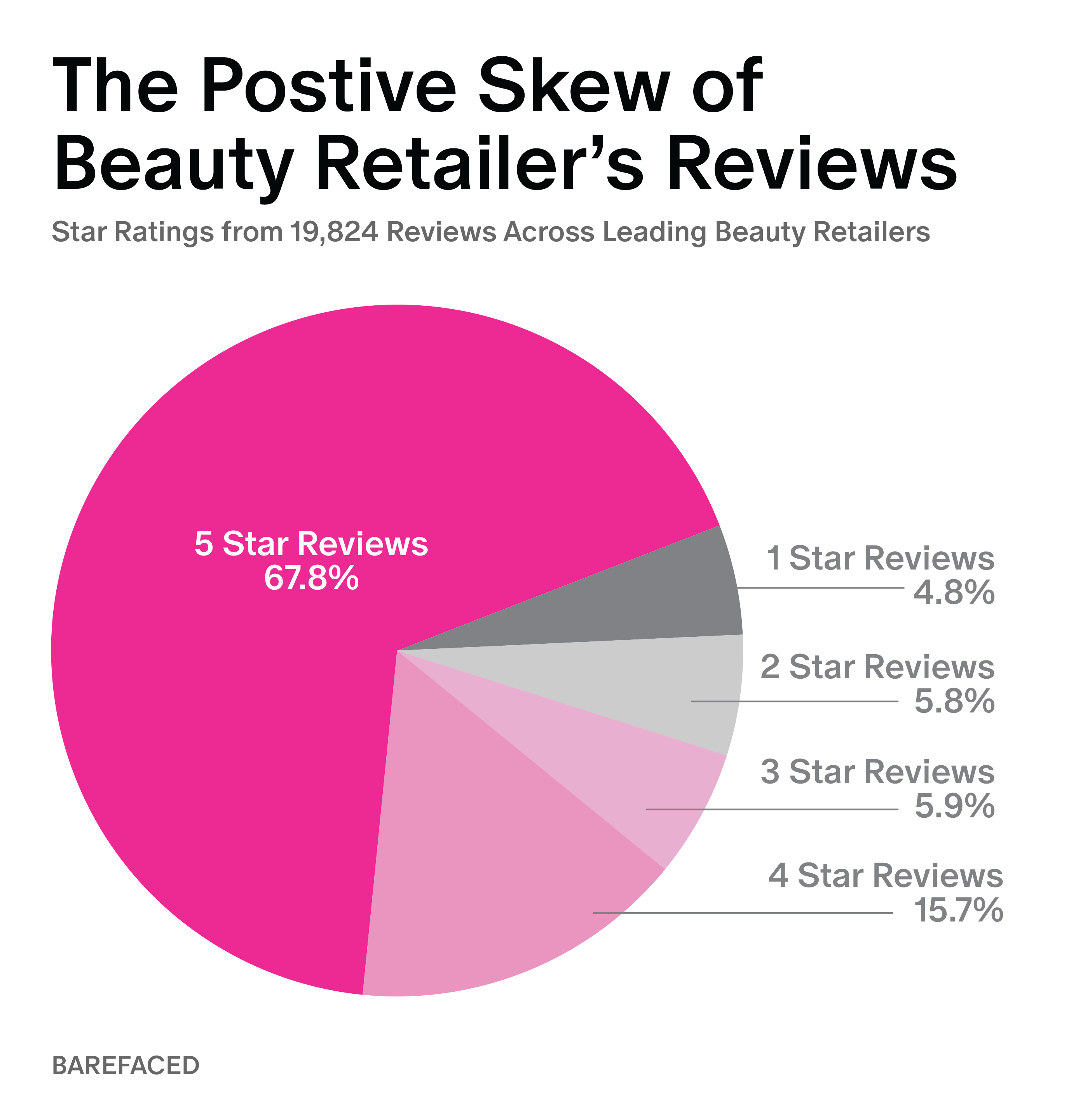
If we set sentiment aside, this data still reveals patterns in product usage among this age group. For example, women over 40 consistently contributed the highest number of reviews across retailers, offering an insight into their preference to “go to the source.” While younger women often share their experiences within peer groups or online communities, mature women appear to value being heard directly by the brand.
Age-old Measures
Among retailers reviews, one pattern stood out immediately – mature women, particularly those over 50, can’t help but mention their age. That might come as a surprise given that asking a woman her age is often considered a cardinal sin in Western culture, but our data suggests mature women freely offer such information to one another online as a metric of truth.
Stating one’s age provides a form of evidence, acting as both a signal to their peers and a measure of a product’s success. “If this works for me,” one retail reviewer wrote, “then it really works.”
“As an almost 70-year-old sun worshipper, I’ve tried almost every line of skincare. The AB line, especially the face oil, has made a big improvement on the condition of my skin. Love it!… just wish it wasn’t so pricey.”
“I’ve used this moisturiser since I was 13 – I’m 47 now. It’s the only product that balances my oily and dry skin and leaves it soft and smooth.”
While younger retail reviewers tended to avoid declarations about their age, the over-50s subset view it as an important credential. Brand loyalty is also framed via time, with statements such as “I’ve used this for 25 years” often followed by praise for a particular product (or frustration if the formula has changed).
Intergenerational influence
Many beauty brands target younger consumers – such as Gen Z or Gen Alpha – with the belief that ‘getting them early’ is the most valuable gateway for brand loyalty across a lifetime.
However retail review data revealed that parent-to-daughter influence was twice as frequent as daughter-to-parent influence. While media coverage has frequently portrayed younger generations as beauty-literate trend-setters who guide their mothers' purchasing decisions, these reviews told a different story. In reality, mothers were more likely to drive skincare purchases for their teens, particularly when addressing acne or irritation, and typically chose affordable, dermatologist-approved brands.
“My daughter loved this product so much that she asked me to get her more… She’s a teen, but this is part of her simple cleanse, moisturize, and protect routine.”
This confirms a critical insight: sales impact lies with whoever holds the wallet, not whoever generates social engagement. Ironically, brands disproportionately measure and prioritise the latter, tracking likes, shares, and influencer metrics from younger consumers, while overlooking the actual purchaser. This measurement bias perpetuates a fundamental misunderstanding of the mature-aged shopper, who remains harder to track through traditional digital analytics. The visibility gap presents a significant problem for brands: they’re optimising for attention from an audience that influences less than they assume, while remaining blind to the demographic that actually drives conversions. (This is a gap Unfiltered is being built to address.)
In contrast, adult daughters acted as brand evangelists for their parents, introducing them to newer, trend-led lines.
“I’ve now got both my sisters, my mum, mother-in-law, and sister-in-law using it. It’s perfect for all skin types.”
Legacy loyalty isn’t a given
If retailer reviews show how mature women speak to brands, Reddit forums show how they speak to each other. While online beauty forums aren't representative of the average department-store shopper, they offer a snapshot of digitally engaged women aged 45+ who actively participate in online beauty communities—researching ingredients, sharing honest experiences, and shaping peer perception in the process.
Culturally, prestige legacy brands such as Clinique, Estée Lauder and Lancôme are often classified as “mature-coded” through marketing efforts that target the demographic. Yet these brands barely register in digital beauty discourse. Analysis of posts and comments in r/45PlusSkincare over the past six months found the top five most-discussed brands to be The Ordinary, SkinCeuticals, CeraVe, Olay and Paula's Choice.
This indicates that within this digital ecosystem, efficacy and value outperform heritage, nostalgia, or targeted marketing efforts for mature women. Olay remains an outlier; the only legacy brand that appears to have successfully evolved its value proposition for a modern, mature consumer that's results-focused and ingredient-aware.
Brand switching within this demographic presents a significant concern for legacy players that went unchallenged for decades. Private conversations I have had with brand executives reveal a common anxiety: these heritage brands are haemorrhaging longtime customers but lack clarity on where they're going and why. The questions they're grappling with centre on cross-brand interaction and switching behaviour—understanding which affordable, efficacy-driven alternatives are capturing their former loyalists. Answers that have long been locked behind the golden gates of panel data.
Local and retailer-level data reveals far more granular switching patterns, alongside questions of what it would actually cost to win them back. Private conversations with retailers have suggested a similar trend: supermarket loyalty data shows that the number of women buying beauty at these more affordable destinations hasn't increased, but the amount they're purchasing has—and critically, the brands they're choosing have shifted. This reveals an openness to trial and a willingness to abandon long-held loyalties in favour of products that deliver results.
How this demographic has been sold to for decades is fundamentally shifting. Without visibility into these behavioural patterns, repositioning efforts remain largely speculative.
Retail vs E-tail
In Reddit conversations where mature consumers discuss where they shop, customer service dominates. The most-cited retailers were specialty giants Ulta and Sephora, followed by brand DTC websites and luxury department store Nordstrom. Mid-tier department store Macy’s also appeared occasionally, but was dwarfed in comparison to its specialty and high-end competitors.
Positive sentiment from mature consumers was directly tied to retail experience. Shoppers praised brands and retailers for colour-matching, consultations and staff expertise, while negative interactions drew the highest amount of criticism—particularly Sephora, for its Gen Z-heavy aesthetic and inconsistent service from sales assistants.
This highlights what most would expect: the continued importance of in-store interactions in shaping brand perception amongst mature demographics, despite increasing digital shopping habits. While they might buy both online and in-store, mature aged women primarily look to the shop floor to determine brand suitability rather than its campaigns.
Beauty's most powerful purchaser isn't invisible; she's just been severely under-measured. As long as mature women remain excluded from digital analysis, both buyers and brands lose out.
Our analysis reveals how hard it is to capture her behaviour—she shops across channels, influences quietly, and leaves a lighter digital footprint than the demographics brands typically track. The visibility gap is real, and it's costing everyone.
If you’re interested in learning more about what we are building with Unfiltered, feel free to shoot me an email at lily@barefaced.media. Otherwise, you can connect with Barefaced across all platforms here.
Such a great article. Clear, concise and highlighting a truly relevant topic that we don't talk about enough.